BIMTA FIELD GUIDE / EDITION 01 / REVIEWED 19 OCTOBER 2026
AI starts with the trades. Make it work for you.
Before a question reaches an AI model, somebody has built the power, cooling and connections behind it. Start there. Then look at what AI can do for your own business.
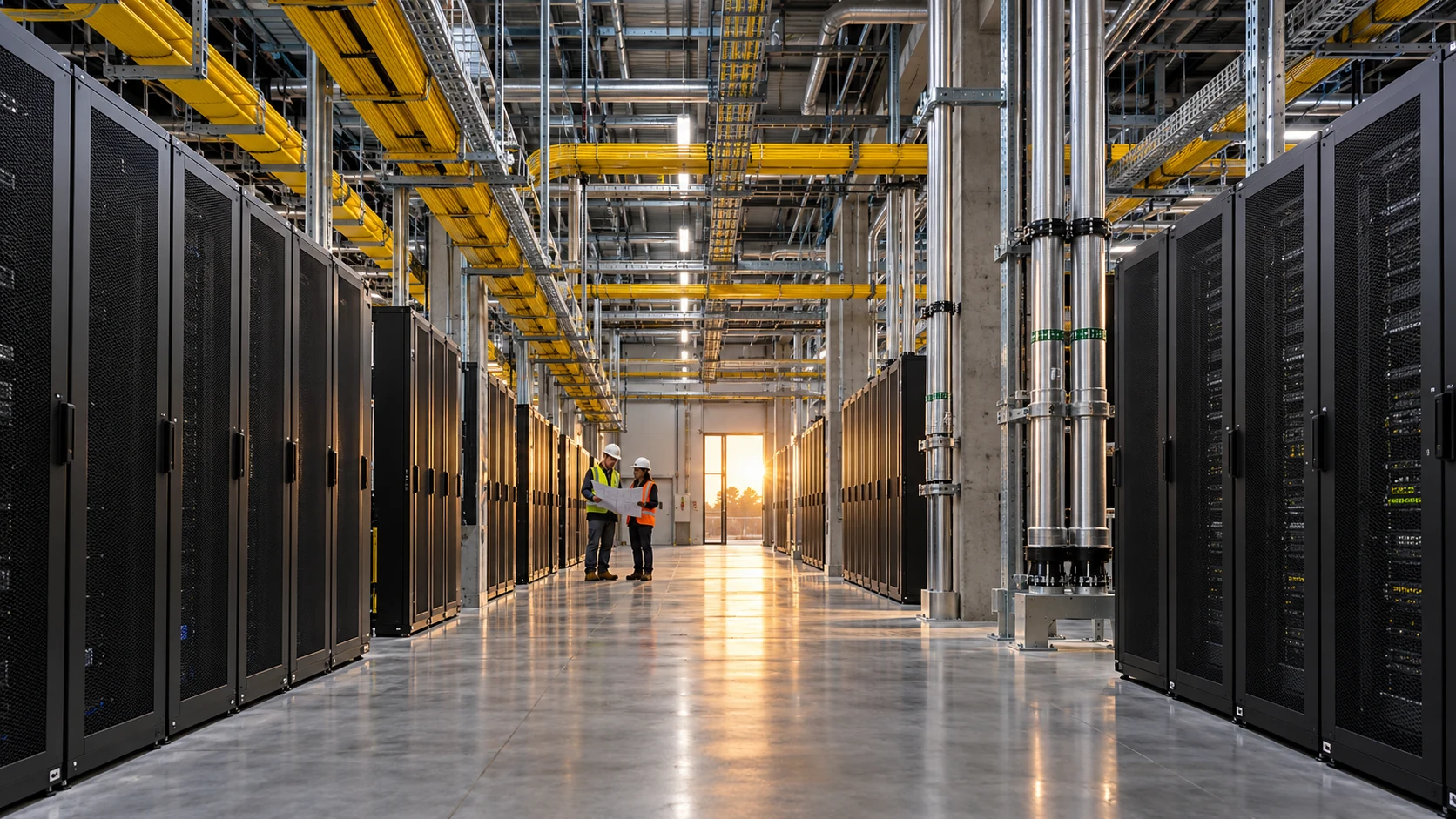
There is a building, a supply chain and skilled work behind the screen. Original AI-generated illustration of a fictional facility, not project photography or an installation design.
THE BIMTA STARTING POINT
Understand what you build. Protect what you know. Measure what you gain.
Walk through the building first.
Picture a mechanical or electrical crew arriving at an AI data centre. The equipment may be unfamiliar, but much of the work is recognisable: supports, pipework, cable routes, power distribution, controls, access and testing. The difference is how closely these systems depend on each other.
A GPU is a processor suited to many calculations running in parallel. AI servers combine processors, memory and network connections; racks organise that equipment. Training develops a model from data. Inference runs an existing model to produce a result. Both need computing capacity, but a small local AI task does not require a new hyperscale building. [1]
What does hyperscale construction mean?
It means delivering very large computing facilities designed to grow through repeatable halls, buildings or phases. The work connects civil and structural construction with power, cooling, communications and commissioning. “Hyperscale” describes scale and expansion; it is not a universal trade specification or proof of AI use.
For a trade, repetition can create prefabrication opportunities. It also magnifies an error repeated across hundreds of assemblies. In BIMTA’s view, the useful model is the one that helps settle interfaces, installation access and release dates before the shop repeats the work.
01
Power + general services
Utility connection, switchgear, backup systems and rack distribution sit alongside lighting, fire protection, security, drainage and building controls. General services are supporting building systems here; the project must define its own package boundaries.
02
Cooling + fans
High-density systems may use liquid cooling alongside air cooling. Coolant distribution units, pipes, pumps, heat rejection and remaining fans must work together. Liquid cooling does not mean every fan disappears.
03
Fibre + cable trays
External fibre connects the campus; internal fibre and copper connect equipment. Trays, raceways, supports, penetrations, patching and maintenance access need coordinated space. Not every connection uses the same cable.
04
Racks + installation logistics
Rack dimensions, weight, floor capacity, delivery routes and lifting plans affect installation. Long-lead electrical and cooling equipment can govern when a hall is ready for its computers.
Educational overview and BIMTA scope interpretation. System examples: NVIDIA’s GB200 architecture and network references. Exact capacities, clearances and installation methods come from the approved design and equipment instructions. [1][2]
Front end, back end: ask which meaning is intended.
In an application, the front end is the interface a person uses; the back end runs processing and data services. In an AI cluster, people may use those names for the access network and the high-speed compute network. Storage and management networks also have distinct roles. The names alone are not enough to specify a cable package. [2]
A useful handoff question
Which network is this route serving, what connects at each end, and who supplies, installs, labels and tests it?
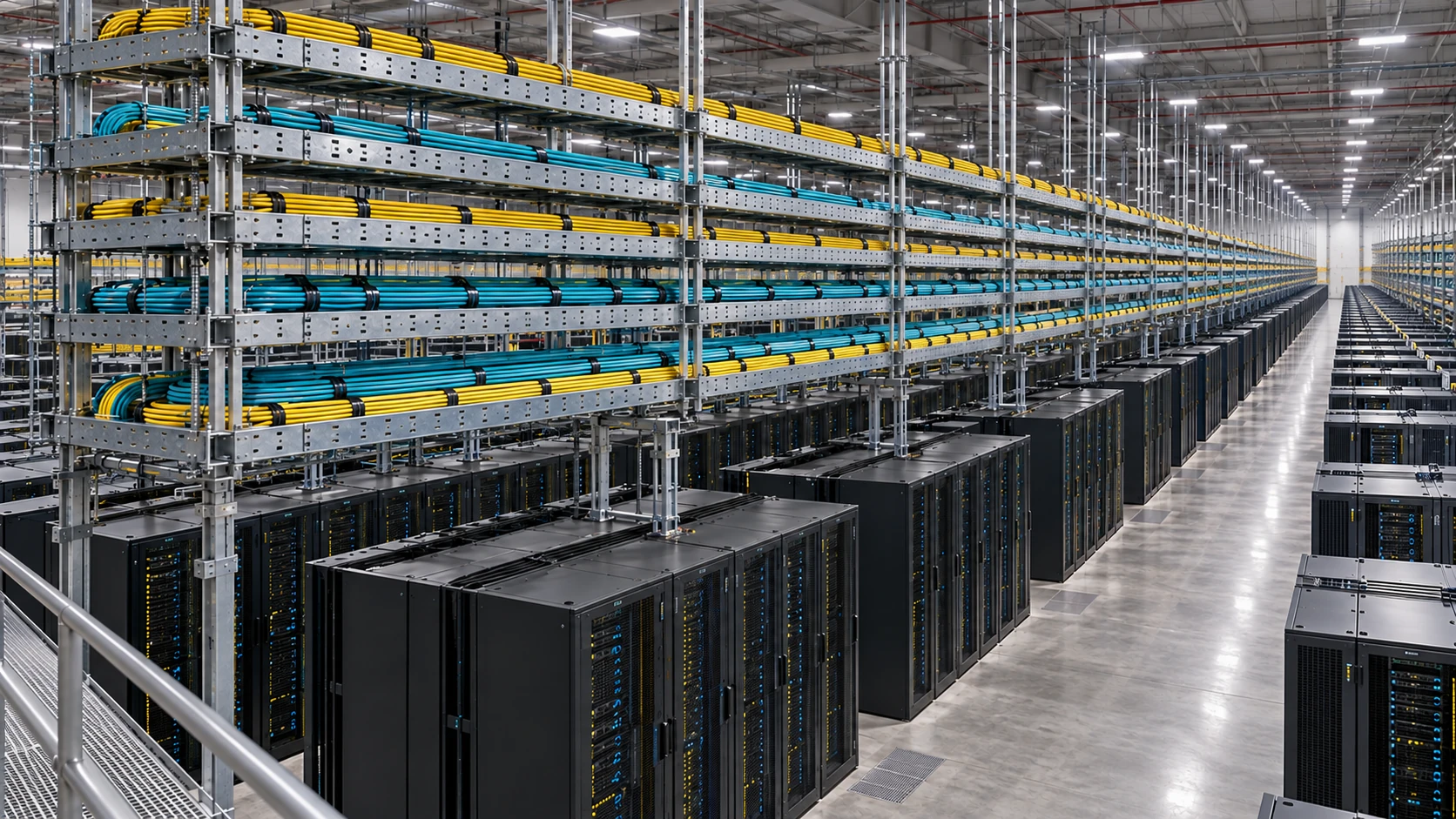
The scale of the coordination task. Five vertically stacked overhead trays above back-to-back server rows and service aisles. AI-generated illustration of scale and coordination, not an installation drawing or engineered support design.
Fibre logistics start before the reel arrives.
A route on a drawing still needs a cable schedule. Match lengths, connector types and polarity to the intended connection; plan delivery, protected storage and installation order. Allow for manufacturer bend and pulling limits, accessible patching, inspection, cleaning and the specified test records. A cable that fits in the tray can still be the wrong cable. [3]
BIMTA perspective: coordinate tray access, cooling interfaces and replacement paths as well as clashes. Ask who owns the connection schedule and what evidence releases the system for service. This is a scope conversation, not an installation procedure.
CANADIAN PROJECT REGISTER / DATED PUBLIC EVIDENCE
A headline is a starting point. A work package is the opportunity.
Explore announced, proposed, operating and construction-stage records. No complete public census of every scheduled Canadian AI facility was established in this review. These are selected traceable records, not all Canadian projects, an open-tender list or a promise of work.
Read the cost before adding it up.
Amounts below are published Canadian-dollar figures where available, not BIMTA estimates. Building costs, tenant hardware, financing, power generation and economic impact are different measures. Campus and tenant announcements can overlap. No national total is calculated. “Not disclosed” means we have not verified a usable public figure.
Dates are the source’s targets, not confirmed delivery commitments. Some records describe existing facilities or proposals with no schedule. An announcement, power application or memorandum is not proof of permits, financing or available subcontract work.
18 of 18 records · search stays on your device
SK / Construction reported
Bell AI Fabric, Sherwood / Regina
Published cost basis
About CAD $1.7B incremental facility capital expenditure
Timing in the source
First stage targeted for first half of 2027; rolling data-hall openings.
300 MW facility. This is not the price of all tenant computers or the later 1.2 GW proposal.
Could exceed CAD $50B at full buildout, including tenant compute and power
Timing in the source
Phased; no firm completion date in the September announcement.
Non-binding MOU for up to 900 MW additional capacity. Includes the original hub; do not add these budgets together. Subject to customers, agreements and approvals.
The following official records widen the research trail. Their current budgets and delivery schedules have not been sufficiently reconciled for a main register card; they are not confirmed tender opportunities.
National cloud investment programs and undisclosed private facilities are not individual project schedules. A province missing from this edition does not mean it has no AI infrastructure.
Each record links to its evidence. Corporate statements describe the proponent’s position; inventory and assessment entries do not certify commercial readiness. No published project in this register has been verified as an air-gapped facility. Check current procurement and approvals directly before committing estimating effort.
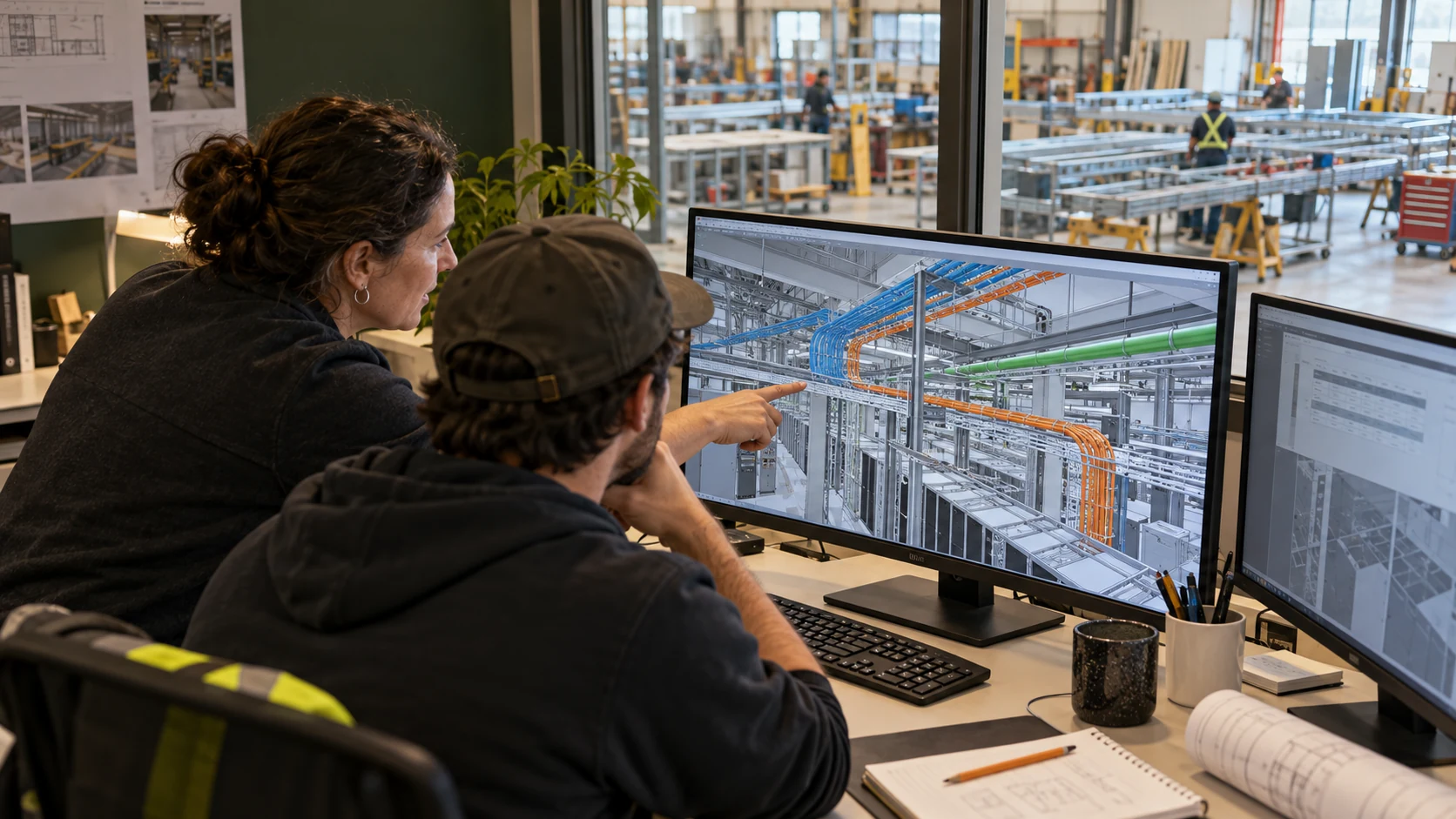
Bring the benefit back to the contractor: fewer repeated steps, checked outputs and useful information for the shop. Original AI-generated illustration; the screen is conceptual, not validated software output.
Now bring AI back to your own desk.
The same contractor helping build AI infrastructure may still spend evenings searching notices, sorting documents and retyping information. That is a sensible place to explore automation. Start with a bounded task and an accepted result, not a promise to automate the company.
01
Find relevant bids
Use authorised notice feeds or downloads to shortlist work by trade, location and closing date. CanadaBuys provides open datasets. An AI summary can help triage; a person must check the original notice, amendments, mandatory criteria and deadline. Respect portal access terms; do not bypass restricted bid rooms.
02
Reduce back-office repetition
Trial document classification, invoice field extraction, draft follow-up messages or internal checklist preparation on approved examples. Check totals, tax treatment and recipient details. Keep payment, payroll and contract commitments with authorised people.
03
Prepare the next project question
Compare authorised document revisions and draft an RFI with its source references. A person checks the actual change and issues it through the required process. A plausible AI answer is not a designer’s instruction.
04
Make BIM automation repeatable
Use AI to help draft a script, then review and test it on a copy. Revit APIs, Dynamo and other rule-based tools can repeat defined operations without a live AI connection. Validate parameters, units, element selection and output before using the result.
These are BIMTA trial ideas, not verified savings claims. Official capability references: CanadaBuys open data, Revit API and Dynamo for Revit 2026. [8][9][10]
If modelling feeds checked prefabrication outputs, the trade may benefit through repeatable assemblies, material planning and fewer manual handoffs. The benefit depends on usable information, authorised fabrication release and what happens in the shop and field. AI is optional; reliable automation is the aim.
Count the complete task.
Compare preparation + execution + checking + correction before and after the trial. Include software, hardware, support and training. Recovered hours only become financial benefit when the business can use them.
Consider an illustrative project where the construction manager wants daily structured progress data to support an AI dashboard. The dashboard might help the project. The trade may still need to collect photographs, assign locations, reconcile quantities and correct mismatches before that information is usable.
That effort is real even when the receiving software calls it automatic. This is a possible scope effect, not a finding that every construction manager imposes these requirements.
BIMTA position: make the extra work visible.
Purpose: what decision will the information support, and what does the trade get back?
Deliverable: which fields, photos, formats, frequency and software versions are required?
Responsibility: who corrects a rejected upload or challenges an incorrect AI progress assessment?
Commercial basis: where are collection, checking, integration, licences and revisions allowed for in the price?
Rights: may the receiver retain, share, analyse or train models on the information? Does that include your methods, rates or libraries?
Clarify through the permitted tender-question process before the deadline. After award, use the agreed change process. These questions do not establish an automatic right to extra payment, permission to withhold required deliverables or a right to qualify a compliant bid.
Your fabrication library, labour history, pricing and project information can carry commercial value or obligations to somebody else. A subscription does not establish permission to upload them. Start with public, synthetic or properly authorised material and disclose only what the task needs.
Data residency
Where information is stored and processed. Ask about prompts, files, outputs, logs, backups and support access, not just the selected server region.
Data sovereignty
Which laws and authorities can govern access, and who has effective control. Canadian hosting is one consideration; ownership, operators, subcontractors and legal exposure also matter.
Canadian Cyber Centre guidance addresses both contractual location controls and supplier risks. Privacy regulators also set out principles for lawful, accountable use of personal information in generative AI. The applicable obligations depend on the organisation, province, information and contract; there is no claim here that every Canadian contractor must keep all data in Canada. [4][5]
Where air-gapped AI can fit.
An air-gapped deployment isolates the system from external networks. It can run a suitable local model on approved infrastructure, from a workstation to a dedicated facility. On-premises does not automatically mean air-gapped; a private cloud is not automatically disconnected.
Cohere publicly offers air-gapped deployment options. That establishes an available vendor model, not proof that a particular Canadian project or service meets your requirements. Local processing can reduce external transfers, but updates, imported files, access controls, backups and output review still need management. [6][7]
There is a practical trade-off.
A disconnected system cannot simultaneously crawl live bid websites. Use a separately approved process to obtain and inspect permitted material before transferring it. Plan hardware, model licences, security support and maintenance as operating costs.
Before connecting an AI service, ask six questions.
Are we entitled to use this information for this purpose?
Where will files, prompts, results, logs and backups go?
Who can access them, including support staff and subcontractors?
Are they retained or used for model training, and can those uses be contractually limited?
Can we export and delete our data, and verify what deletion excludes?
Who checks outputs, approves actions and handles a mistake?
A “no training” setting addresses one use of data. It does not answer every question about retention, access or location. BIMTA’s preference is to prove a small, useful workflow before expanding the information it can reach.
Begin with one useful result.
Pick one recurring task. Define the input and acceptance check. Trial it with approved sample data, record errors and total effort, then keep a versioned method with a recovery step. If the work does not become more dependable or valuable, change the approach.
BIMTA perspective: the trades should benefit from AI, whether they build its infrastructure or use it in the office. More information and more software are only worthwhile when they help deliver an accepted result.
Evidence, without the noise.
Project sources sit beside each record. Expand the reference notes below for the technical and Canadian information used in this guide. Reviewed 19 October 2026; this page is not an automatically updated feed.